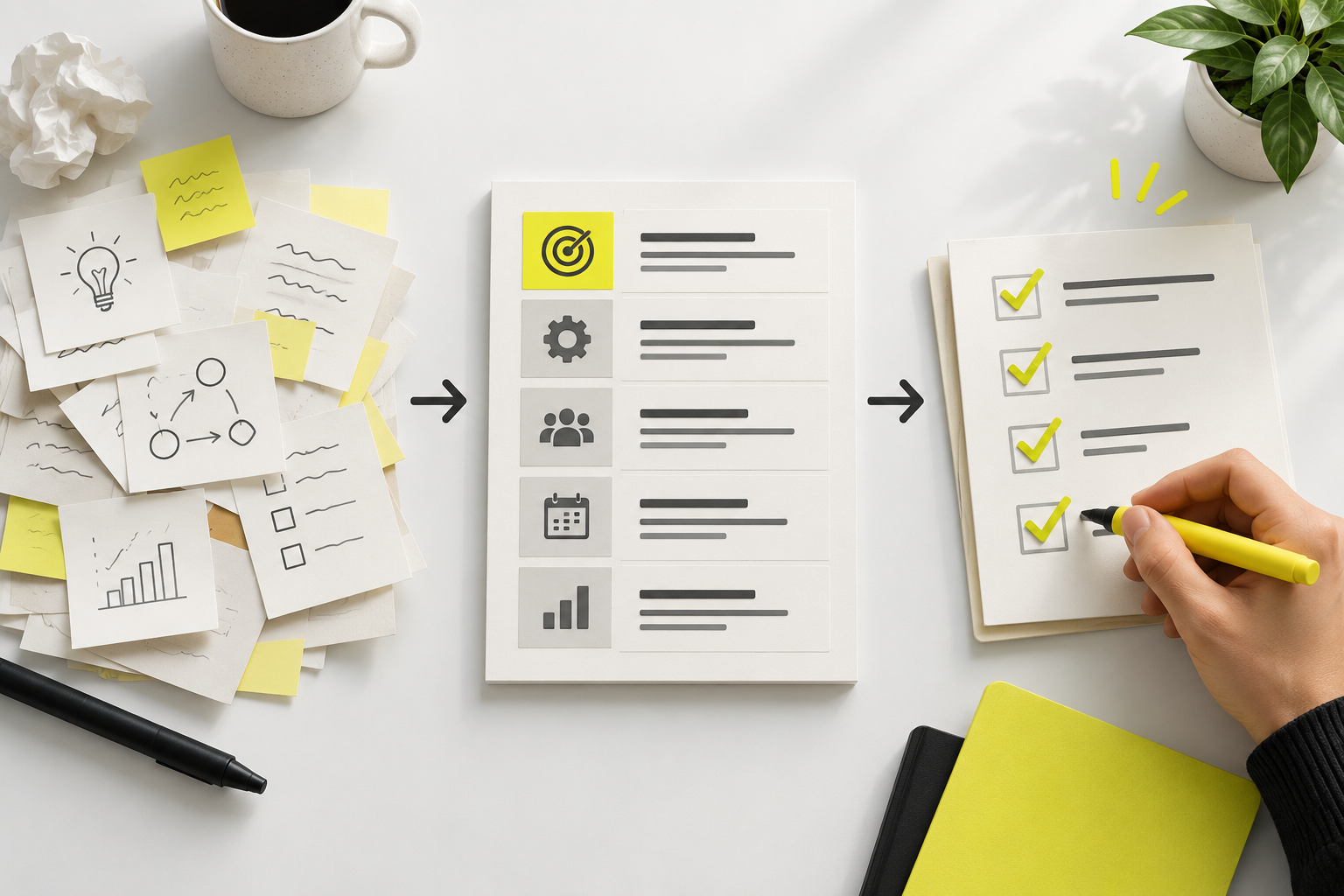
Compare routes for turning project information into useful reports. Check whether teaching covers the data source, analysis and validation, as well as the final chart or status summary.
Choose a repeatable exercise
Build a status update from a sample dataset; verify every number and flag missing data.
This is an editorial practice suggestion, not a claim that every listed course includes this exercise. Check each provider’s advertised curriculum.
54 PM-specific routes and 80 broader workflow routes mention this task. Labels below keep the two collections separate.
Primary page includes 100+ Excel formula/function examples and a named lesson on using ChatGPT for Excel formulas; workbook topics include cleanup and dashboards.
Scrum-team communication training covers AI meeting agendas and transcripts, project tool coordination, dashboards and knowledge hubs, with structured prompting and five listed assignments.
Six modules progress from autonomous-agent concepts and daily email/calendar automation through research/content pipelines, Notion project coordination, customer-support routing, invoice/PDF extraction and multi-agent orchestration.
Listed tools include ChatGPT and generative AI
examples name Gmail, Google Workspace and Notion. Course outcomes emphasize designing/deploying autonomous agents and operational guardrails.
FAQ examples identify AI use to draft agendas, follow-up emails, reports/status updates, extract document data into spreadsheets, and create research/synthesis briefings.
and a reviewed AI project capstone/application plan. Named outputs include a use-case scorecard, prompt pack, charter/WBS/milestones, RAID register/change brief, meeting/action records, checked status workbook/management pack, PMO workflow/checklist and role-specific project pack.
Live / instructor-ledEnglish, Arabic or bilingual by team choice
Day one covers lifecycle use cases, scope/schedule/WBS support, resource/cost/scenario analysis and risk identification/mitigation. Day two covers progress analysis and early-warning indicators, executive dashboards/status narratives, stakeholder/meeting workflows, governance, confidentiality and an implementation plan.
Custom modules cover initiation, planning, execution, monitoring/control, advanced decision support and a project-management capstone simulation, using charters, plans, risk records, status reports and stakeholder communications.
AI for scoping, task structuring, risk/issue/dependency identification, stakeholder communication and documentation, status reports, dashboards, meeting outputs, governance, AI risk and a project-improvement plan.
The outline distinguishes AI projects from traditional work and covers vision, objectives, stakeholders, scope and resources, timelines, delivery methods, technical tools and data sources, testing and evaluation, multidisciplinary team coordination, KPIs, model/data quality, legal and ethical risks, delivery reporting, lessons learned and scaling plans.
The provider outline includes AI fundamentals and project cases, identifying AI opportunities, predictive scheduling and forecasting, risk and issue tracking, resource allocation, dashboards, governance, privacy, change management and a digital PM roadmap.
Use a realistic AI/hybrid project case to plan, identify, analyze, respond to and monitor project risks; build a risk breakdown structure and register, apply qualitative scoring and Expected Monetary Value/decision trees, and define response, fallback and dashboard indicators.
Topics cover the project life cycle, logical framework, AI forecasting and scenario planning, Gantt/PERT estimates, monitoring and evaluation, risk prioritization, data quality, automation, dashboards, reporting, governance, ethics and data security.